
Model Reverse Engineering
Model reverse engineering is an attack on an AI application in which an adversary attempts to reconstruct or approximate the deployed model. By systematically sending inputs to the model through an exposed API and observing the outputs, the adversary collects enough input-output data points to train a surrogate model that mimics the original model’s behavior. This process can be executed as a black-box attack, i.e., it does not require access to the internal model architecture or training data, making it particularly dangerous for publicly accessible AI applications.
This type of attack poses multiple risks. For commercial ML providers, model reverse engineering can result in intellectual property theft, potentially undermining years of research and development investment. For security-sensitive applications, such as spam detection, facial recognition, or fraud detection systems, an extracted model can be used to probe for vulnerabilities or generate adversarial examples that bypass defenses. Moreover, if the original model is trained on sensitive data, a sufficiently accurate clone could be used for model inversion attacks, where the adversary attempts to reconstruct sensitive information about the training data.
Reverse Engineering an ML Model
Let us explore a basic example of a model reverse engineering attack. Although the following implementation is not feasible for larger and more complex models, the underlying concept remains the same.
The Classifier
In this section, we will explore a classifiers two species of penguins, Adélie and Gentoo, based on their flipper length in Millimeters and body mass in Grams. This classifier is based on a well-known public dataset. Furthermore, the classification task does not require a complex classifier. As such, we could easily train a similar classifier ourselves based on the public dataset. However, for this section, we will assume that the training data is not publicly available, such that we need to execute a model reverse engineering attack to obtain our own classifier.
The classification service is provided in a web API, enabling us to interact with the classifier by providing the two variables, flipper length and body mass, in the GET parameters flipper_length and body_mass, respectively:
khoafrancisco@htb[/htb]$ curl 'http://172.17.0.2/?flipper_length=150&body_mass=5000'

{"result": "Adelie"}
Sampling Datapoints
To reverse engineer the model, we first need to sample data points on which to train the surrogate model. For this, we need to generate pairs of flipper length and body mass. We can then run the model on these input pairs to obtain the corresponding output. In the final step, we can use these input-output data points to train our classifier.
In our code, we will random generation to obtain a large number of input data points. To improve the data quality, we should consider prior information in our sampling process. For instance, we could research a realistic range of penguin flipper lengths and body masses to obtain lower and upper boundaries. This ensures that we only obtain high-quality data points in our random samplings, thereby improving training performance by reducing the number of data points required for the training process. Depending on the type of classification problem, we may be unable to define meaningful boundaries for our input data points. In this cases, we need a significantly larger number of data points to successfully reverse-engineer the model, due to the lower quality of the data.
In our example, we will restrict the flipper length to 150-250mm and the body mass to 2500-6500g. Let us start by defining the following parameters for our code:
N_SAMPLES = 100

MIN_FLIPPER_LENGTH = 150
MAX_FLIPPER_LENGTH = 250

MIN_BODY_MASS = 2500
MAX_BODY_MASS = 6500

CLASSIFIER_URL = "http://172.17.0.2:80/"
Now, we can uniformly sample random data points within these boundaries:
import random
import pandas as pd

samples = {
    "Flipper Length (mm)": [],
    "Body Mass (g)": []
}

for i in range(N_SAMPLES):
    samples["Flipper Length (mm)"].append(random.uniform(MIN_FLIPPER_LENGTH, MAX_FLIPPER_LENGTH))
    samples["Body Mass (g)"].append(random.uniform(MIN_BODY_MASS, MAX_BODY_MASS))

samples_df = pd.DataFrame(samples)
print(samples_df.head())
Executing the code, we can observe the first couple of data points we generated:
Model Reverse Engineering
khoafrancisco@htb[/htb]$ python3 model_stealer.py

   Flipper Length (mm)  Body Mass (g)
0           249.330146    3107.061717
1           249.818948    6443.306983
2           210.936472    4121.976351
3           208.697770    5145.900243
4           158.819736    3882.060817
For the training process, we require the respected classis for all input data points. To obtain these, we can feed the input data to original model via web API and observe the predicted classes. In out code, we can achieve this by iterating over the generated data points, calling the web API, and storing the predicted classes in a new DataFrame:
import requests
import json

predictions = {"species": []}

for i in range(N_SAMPLES):
    sample = {
                "flipper_length": samples["Flipper Length (mm)"][i],
                "body_mass": samples["Body Mass (g)"][i]
            }
    prediction = json.loads(requests.get(CLASSIFIER_URL, params=sample).text).get("result")
    predictions["species"].append(prediction)

predictions_df = pd.DataFrame(predictions)
print(predictions_df.head())
As a result, we now know the predicted classes for all randomly generated data points:
khoafrancisco@htb[/htb]$ python3 model_stealer.py

  species
0  Gentoo
1  Gentoo
2  Gentoo
3  Gentoo
4  Adelie
Replicating the Model
The final step in reverse engineering the original model to train the surrogate model on the data obtained in the previous step. One of the main factors deciding the model’s quality is the model architecture we choose. While different model architectures are known to perform well for specific tasks, such as CNN architectures for images classification or LLM architectures for text generation, we often do not know the exact architecture used by the original model. As such, it is often impossible to re-create the original model exactly. However, choosing an identical architecture is often not required, as long as, we select one that suits the specific task we want the model to accomplish.
In our penguin example, we will train a Logistic Regression classifier since we are interested in a binary classification setting. For more details on this type of classifier, refer to the Fundamentals of AI module.
We can train a classifier on our training data using the following code:
from sklearn.pipeline import make_pipeline
from sklearn.preprocessing import StandardScaler
from sklearn.linear_model import LogisticRegression
import joblib

surroggate_model = make_pipeline(StandardScaler(), LogisticRegression())
surrogate_model.fit(samples_df, predictions_df)

#save classifier ti a file
joblib.dump(surroggate_model, 'surroggate.joblib')
Evaluation
To submit the surrogate model to the lab, we can upload it to the lab’s /model endpoint:
with open('surrogate.joblib', 'rb') as f:
    file = f.read()

r = requests.post(CLASSIFIER_URL + '/model', files={'file': ('surrogate.joblib', file)})

print(json.loads(r.text))
Executing the code, the lab returns the accuracy we achieved on a test set:
khoafrancisco@htb[/htb]$ python3 model_stealer.py

{'accuracy': 0.9854014598540146}
As we can see, the surrogate model achieved an accuracy of more than 98%, which is an excellent result considering we only sampled 100 data points. Remember that we were able to train this classifier without access to any real-world training data, as we randomly generated data points and used the web API to obtain the target classes.
Comparing the Models
As a final step, let us take a look behind the scenes and compare the surrogate model to the original one. The decision boundary of the original model looks like this:
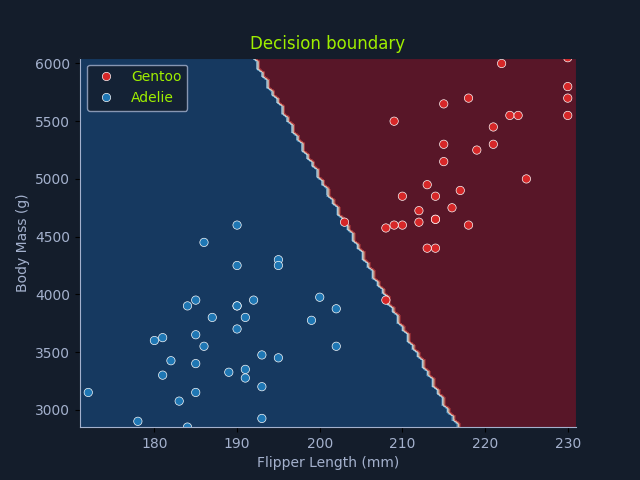
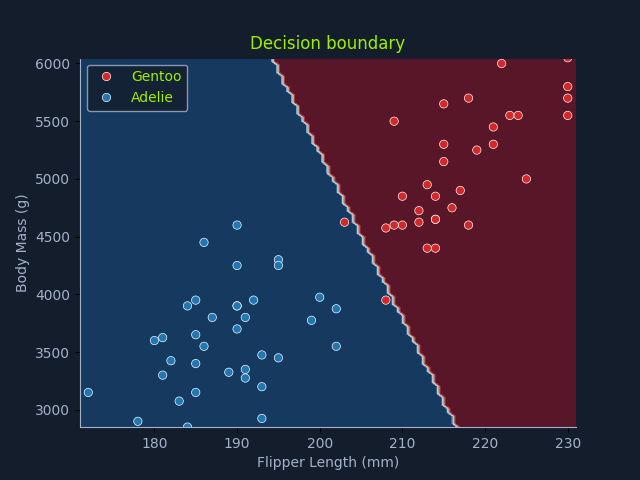
The decision boundary of the surrogate model is only marginally different from that of the original model. By training the classifier on more data points, we can further reduce the difference.
Mitigations
Since attackers conducting a model reverse engineering attack query the model like any benign user, mitigating these attacks is challenging. Restricting access to the model completely by blocking access to the available service, e.g., a web API, would also severely affect benign users. However, many real-world models worth protecting from model reverse engineering are significantly more complex than the one we discussed. Therefore, attackers require a lot of data points to reverse engineer the model, many magnitudes more than what we implemented in this section. Since the adversary must query the original model for every data point to obtain the target value, they produce significant network traffic. Model reverse engineering attacks can thus by mitigated or slowed down by limiting access to the model. Typical examples for this include rate limiters in web APIs that only allow a fixed number of queries in a specific time frame. Depending on the rate limiter’s configuration, it can effectively mitigate model reverse engineering. However, it is crucial not to be overly strict with rate limiter configurations so as not to impede benign user queries.
About the author
- Mình thích tìm hiểu công nghệ đặc biệt về lĩnh vực an toàn thông tin. Mình có ghi chú các bài này chủ yếu luyện tiếng Anh và đọc thêm. Cảm ơn mọi người đã quan tâm và đón đọc. Nếu có góp ý gì xin hãy liên lạc với mình nhé!
Comments
Join the discussionNo comments yet. Be the first to comment.